
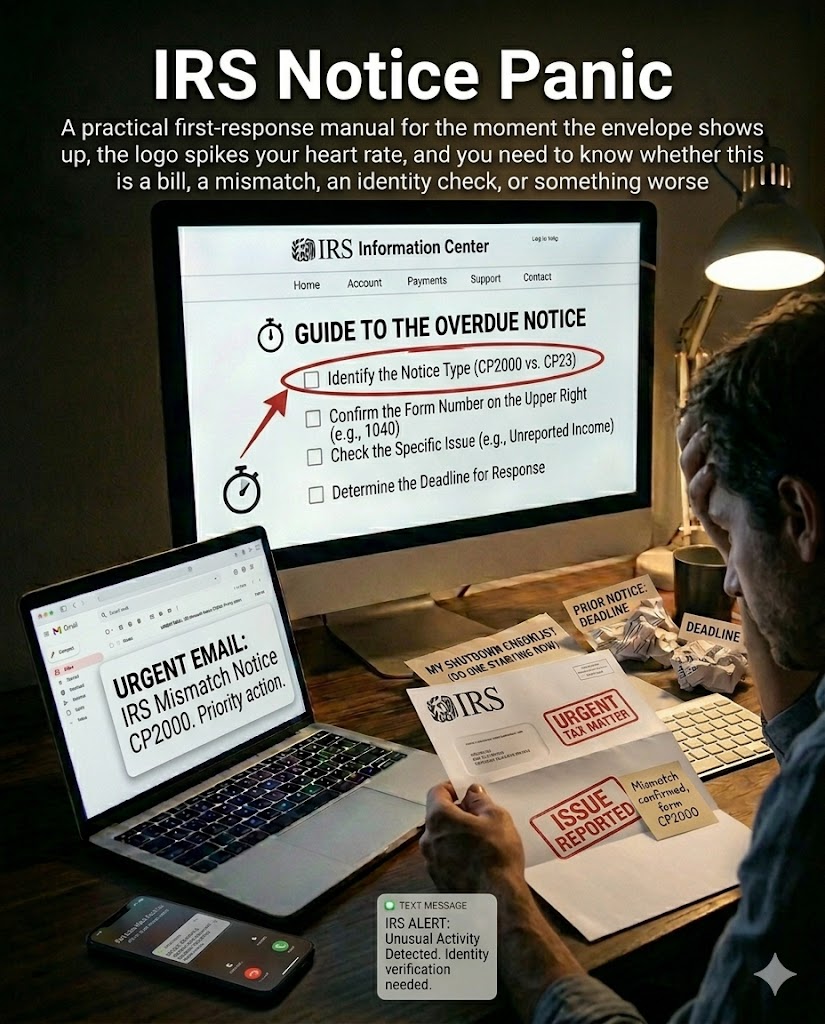
A practical first-response manual for the moment the envelope shows up, the logo spikes your heart rate, and you need to know whether this is a bill, a mismatch, an identity check, or something worse
This is one of those moments where people make the situation more expensive by reacting to the logo instead of the document. The IRS says it sends notices and letters for several very different reasons, including a balance due, a changed refund, questions about a return, identity verification, corrections to a return, or processing delays. Those are not the same problem, and your first job is to figure out which problem this actually is. (IRS)
The first rule is simple:
Do not ignore it, and do not assume every IRS notice means an audit, lawsuit, or disaster.
Many notices are fixable or informational if handled in time. But deadlines and response instructions matter, and penalties and interest can continue if you owe money and do nothing. The IRS says penalties and interest generally continue to accrue until the balance is paid in full. (IRS)
1) What this manual is for
Use this if:
- you got an IRS letter and do not know what it means
- the notice says you owe money
- the IRS says your return does not match information it received
- the IRS wants to verify your identity
- your refund changed
- you are scared of making it worse by doing the wrong thing first
The practical goal is not to “solve the IRS.” It is to identify the lane:
- balance due
- underreported income / mismatch
- identity verification
- return correction / adjustment
- delay / processing issue (IRS)
2) The first 20 minutes
Do this first:
- Open the notice.
- Find the notice or letter number.
- Find the tax year involved.
- Find the response deadline.
- Find what the IRS says changed or is needed.
- Pull the tax return for that year.
- Pull any W-2s, 1099s, prior notices, and proof of payment.
- Do not throw it in a drawer because you are scared.
The IRS’s general notice page is explicit that you should read the notice carefully and compare the information with your tax return. That is the first move, not guessing, not ranting, and not waiting for courage. (IRS)
3) The most important first question
Ask:
“What kind of notice is this?”
Because the response to:
- a CP14 balance due notice
is not the same as - a CP2000 underreported income notice
or - a 4883C identity verification letter. (IRS)
If you answer that question correctly, the next steps get much clearer.
4) If it is a bill: CP14 or similar balance-due notice
A CP14 is the IRS’s notice telling you that you owe money on unpaid taxes. The IRS says a CP14 generally shows the amount due, including tax, penalties, and interest, and tells you how and when to pay or how to contact the IRS if you disagree. (IRS)
Practical rule
Do not treat a balance-due notice like a mystery. Treat it like a debt statement:
- what tax year?
- what amount?
- why?
- do you agree?
- if yes, how will you pay?
- if not, what records prove the error?
Script
I received notice [notice number] for tax year [year]. I am reviewing the amount claimed and need to confirm the basis for the balance and my response options.
That is a much better first move than either blind payment or blind panic. The IRS says if you agree with the notice, pay what you can, even if you cannot pay in full, because interest and penalties may continue. (IRS)
5) If it is a CP2000: underreported income / mismatch notice
A CP2000 is not the same thing as an audit. The IRS says a CP2000 is a notice proposing changes because the income or payment information the IRS received from third parties does not match what was reported on your return. The IRS also says a CP2000 is a proposal, not a bill, although it can become one if you agree or do not respond properly. (IRS)
Practical rule
Do not react to a CP2000 by instantly paying.
First check:
- which payer or form is involved
- whether the income really was omitted
- whether basis, expenses, or offsets were missing
- whether the IRS’s proposed change is incomplete or wrong
Script
I received a CP2000 for tax year [year]. I am reviewing the proposed changes and the underlying income documents before responding.
The IRS says you should compare the notice with your return and respond by the date on the notice, whether you agree or disagree. (IRS)
6) If it is identity verification: 4883C or similar
If the IRS sends a 4883C, the issue is usually identity verification, not “you owe immediately.” The IRS says Letter 4883C asks you to contact the IRS so it can verify your identity and continue processing your tax return. (IRS)
Practical rule
Do not ignore identity-verification letters.
This is not a “later” problem.
Why this matters
If the IRS is trying to verify that the return is really yours, delay can stall the return and raise broader identity-theft concerns.
Script
I received Letter 4883C and am calling to complete identity verification for my return.
The IRS’s identity-verification instructions require you to contact the IRS and have documents ready. Treat that as a time-sensitive administrative step, not a weird optional request. (IRS)
7) The hidden danger: penalties and interest do not care about your avoidance
If you owe tax and do nothing, the meter may keep running. IRS Topic 653 says penalties and interest can continue to accrue until the balance is paid in full. (IRS)
Practical rule
If the notice is a real balance-due notice and you agree with it:
- do not wait until you can pay everything perfectly
- check payment plan options early
- pay what you can if full payment is not possible
The IRS’s general notice and payment materials point people toward online accounts and installment agreement options if they cannot pay in full immediately. (IRS)
8) The second fatal mistake: assuming every notice is automatically correct
Some are.
Some are not.
A CP2000, especially, can be wrong in full or in part because the IRS may have incomplete information even when the third-party document is real. For example:
- stock-sale basis missing
- rollover not recognized properly
- duplicate or corrected information returns
- business expenses not reflected in the third-party data
That is why the IRS says to compare the notice to your return and the records used to prepare it, and then respond by the deadline indicating whether you agree or disagree. (IRS)
Practical rule
Do not confuse:
- official-looking
with - automatically correct
9) The best first response for any IRS notice
Start with this logic:
If you agree
- respond/pay as directed
- pay what you can
- set up a payment plan if needed
If you partly agree
- respond with the parts you agree with
- explain the parts you dispute
- include supporting records
If you disagree
- respond by the deadline
- explain clearly and briefly why
- attach copies, not originals, of relevant documents
IRS notice guidance repeatedly points people back to the same basics: read carefully, compare to your records, and respond by the stated date. (IRS)
10) What not to do
Avoid these mistakes:
Mistake 1: ignoring the notice
This is how a manageable issue grows teeth.
Mistake 2: assuming every IRS notice is an audit
A CP2000, for example, is not an audit; it is a proposed adjustment notice. (IRS)
Mistake 3: paying a CP2000 before understanding the proposed change
You may be agreeing to a bad number.
Mistake 4: missing the deadline on identity verification
That can stall your return or complicate processing. (IRS)
Mistake 5: throwing away old tax records
Those records are often exactly what you need to respond.
Mistake 6: waiting for “the final scary letter”
Penalties and interest can keep growing if a real balance is owed. (IRS)
11) The one question to ask if you feel overwhelmed
Ask:
“What exact action does the IRS want from me by what exact date?”
That question cuts through most panic.
Because the answer is usually one of:
- pay
- verify identity
- review proposed changes
- send documents
- call
- do nothing because it is informational only
The IRS’s notices and letters hub is built around that logic: the notice tells you why the IRS is contacting you and what it needs next. (IRS)
12) If you cannot pay
Do not disappear.
IRS Topic 653 says if you cannot pay in full, you should still pay as much as you can and consider payment options, including installment agreements. (IRS)
Script
I received notice [number] and want to resolve the balance, but I cannot pay in full today. I need to understand my payment-plan options and what I should do next.
That is much better than silence.
13) If you think the notice is tied to identity theft
Treat that separately from an ordinary balance issue.
If the IRS is sending identity-verification letters or the return activity is not yours, do not solve this as if it is only a tax math problem. The IRS’s 4883C guidance is specifically about confirming identity before continuing processing. (IRS)
Practical rule
Unknown return activity + IRS identity letter = not a “handle later” situation.
14) The clean sequence
If an IRS notice arrives, the right order is:
- identify the notice number
- identify the tax year
- identify the deadline
- identify whether it is a bill, proposal, identity check, or correction
- compare it to your return and records
- respond by the stated date
- if money is owed, deal with payment or payment-plan options early
That is the sequence.
Not:
- panic
- assume audit
- ignore
- wait for worse
15) Panic-mode version
If your brain is fried, do only this:
- open the notice
- find the notice number
- find the deadline
- find the tax year
- identify whether it is a bill, proposal, or identity check
- pull that year’s return
- do not ignore it
That is enough for today.
16) One-paragraph summary
An IRS notice is not one thing. The IRS says it may send letters because you owe money, your refund changed, it has a question about your return, it needs to verify your identity, it corrected your return, or processing is delayed. A CP14 is generally a balance-due notice; a CP2000 is generally a proposal based on mismatch information, not an audit; and a 4883C is an identity-verification letter. Read the notice carefully, compare it with your return and records, and respond by the stated date. If you owe and cannot pay in full, the IRS says to pay what you can and look at payment-plan options because penalties and interest may continue to accrue. (IRS)
Super-useful reads:
Micro Crisis Survival Manual #6: Dealing With Medical Bill Panic
31-Day Real World Investing Challenge
Finance & Banking Speak for Non-Finance People
The FinTok Starter Pack: 78 Days to Adulting & Money Confidence

