
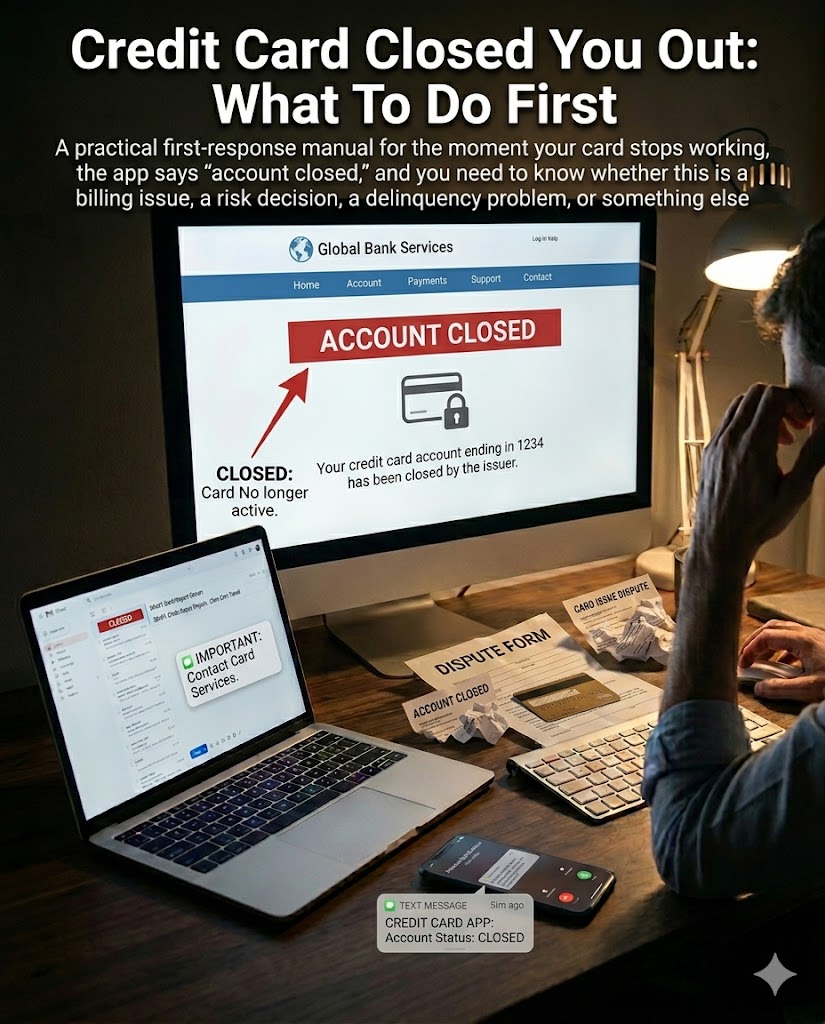
A practical first-response manual for the moment your card stops working, the app says “account closed,” and you need to know whether this is a billing issue, a risk decision, a delinquency problem, or something else
This is one of those financial moments where people make it worse by reacting blindly.
They:
assume the bank made a mistake
keep swiping the dead card
panic-pay without understanding what happened
miss the notice explaining why the account was closed or reduced
confuse fraud protection, delinquency, inactivity, and risk review
start arguing before they know whether the issue is fixable
The first rule is simple:
A closed credit card account is not one problem. It is several different problems wearing the same label.
And which one it is determines what you do next.
Current CFPB rules make clear that adverse action notice requirements apply to decisions involving existing credit accounts, not just new applications, and the notice must accurately and specifically identify the principal reason or reasons for the action. CFPB’s Regulation B definitions also state that if a credit card issuer terminates an open-end account in a way that counts as adverse action, notice is required.
What this manual is for
Use this if:
your credit card was suddenly closed
your purchase was declined and the issuer then said the account was shut
your limit was slashed and the card is effectively unusable
the issuer says there was a “review” or “business decision”
you need to know whether this is about delinquency, risk, inactivity, disputes, fraud, or your broader credit file
This is mainly U.S.-focused because the notice and credit-report rules here are built around U.S. consumer-credit law.
The first truth: “closed” can mean very different things
A card can get shut down for very different reasons, including:
serious delinquency or default
issuer risk review based on your credit profile
inactivity
suspected fraud or security concerns
repeated returned payments
over-limit or payment problems
a broader account-management decision by the issuer
Do not treat all closures like the same event.
Because the response to:
“we closed this after missed payments”
is not the same as the response to:
“we closed this after a risk review”
or
“we froze this because of suspicious activity”
If the issue is only a declined card at checkout, FTC consumer guidance says the first move is to contact the card issuer directly to find out what the problem is and how to fix it.
The first 20 minutes
Do this first:
Check whether the account is marked closed, restricted, frozen, or just declined.
Save screenshots from the app or website.
Look for emails, letters, or alerts from the issuer.
Check whether there was a recent missed payment, returned payment, dispute, fraud alert, or large balance jump.
Do not call and rant before you know whether the issue is fraud, collections, or an actual account closure.
Do not assume you can simply reopen it.
Practical rule
Your first job is not to “fight the bank.”
Your first job is to identify which kind of closure this is.
The most important first question
Ask:
“Was the account closed because of delinquency/default, suspected fraud, inactivity, or an issuer credit decision?”
That question matters because:
If it is fraud/security related
The account may be replaceable or restorable after verification.
If it is delinquency/default related
You may be in collections, acceleration, or charge-off territory soon, and the fix is not “customer service charm.”
If it is inactivity related
The account may simply be gone, and the real issue becomes credit-utilization and available-credit impact.
If it is a risk/credit decision
The issuer may have closed it because of information in your credit file or internal account-management criteria.
And if the closure was an adverse action tied to creditworthiness or account review, accurate notice matters. CFPB’s 2023 adverse-action circular says the creditor must accurately and specifically identify the principal reason or reasons, including for existing-account decisions.
Read the notice before you improvise
If the issuer made a credit decision on the account, look for:
a letter or secure-message notice
reasons like delinquency, high utilization, too many recent obligations, returned payments, or other risk factors
whether a credit report or credit score was used
whether the notice gives you bureau information or score factors
The ECOA/Regulation B sample adverse-action forms are designed for actions on applications and accounts, and CFPB has stressed that these notice requirements apply to all credit decisions, including account actions.
Practical rule
Do not argue from memory.
Argue from the notice.
If the issuer used your credit report or score
If the closure, limit cut, or other account action was based on your credit report, the adverse-action notice usually matters a lot.
Why:
you may have a free-report right from the credit bureau named in the notice
the notice may include score factors
the real problem may be report errors, identity theft, utilization spikes, or derogatories you did not know were hitting you
This is where “my card got closed” can actually become:
a credit report error problem
an identity theft problem
a broader debt/utilization problem
If you suspect the underlying report data is wrong, CFPB rules allow direct disputes with furnishers on issues including your liability for a credit account or other debt, and bureaus/furnishers each have dispute obligations under the FCRA framework.
If the closure followed a billing dispute
This is a very specific situation.
CFPB’s Regulation Z says a creditor cannot accelerate debt or restrict or close an account solely because the consumer exercised good-faith billing-error rights under that section.
That does not mean every closure after a dispute is illegal.
It does mean:
if the issuer says or implies the closure happened because you exercised a valid billing-error right in good faith, that raises a real issue.
Practical rule
If the shutdown followed a charge dispute or billing-error fight, do not reduce the whole thing to “they can do whatever they want.”
Script
I want to confirm the exact reason the account was closed or restricted, including whether this action was related to my exercise of billing-error or dispute rights.
If the closure followed missed or returned payments
This is a different lane.
In that case, the account closure may be less about report error and more about:
default risk
issuer collections policy
payment failure history
returned ACH payments
broader account deterioration
Practical rule
Do not waste time pretending this is a mystery if the issue is clearly delinquency.
What you need then is:
balance status
minimum due / accelerated due status
whether the account is still with the issuer or moving to collections
whether hardship options exist
whether the closure is reversible or final
The problem is no longer “why did they do this?”
The problem is “what happens to the debt now?”
If the closure was because of fraud or suspicious activity
This is one of the few scenarios where the account may not be “dead” in the normal sense.
If the card stopped working because of suspicious transactions, wrong-device login, or issuer fraud detection, the likely issue is:
account protection
identity verification
card replacement
temporary restriction
FTC guidance on lost or stolen cards says to follow up immediately in writing after reporting a card issue and keep notes of when you reported it.
Script
Please confirm whether this is a fraud-related restriction or a permanent closure, and what verification or replacement steps are required.
This is much better than:
“Why did you close my account?”
because it distinguishes security action from final shutdown.
If the issuer says it was a “business decision”
That phrase is often a black box.
Sometimes it means:
internal risk review
portfolio management
concerns from your broader credit file
spending/payment pattern change
something they do not feel like explaining conversationally
That is exactly why written notice matters when the action counts as adverse action.
CFPB’s 2023 circular specifically warned creditors that adverse-action reasons must be accurate and specific, even when complex models or internal systems are involved.
Script
Please confirm the principal reason or reasons for the account closure and whether any consumer report or credit score information was used in making that decision.
That is cleaner than asking “what do you mean business decision?”
The utilization trap
If a credit card is closed — especially one with a large limit — your overall credit-utilization ratio can get worse fast, even if your spending did not change.
So a closure can become two problems:
lost access to the account
collateral damage to your credit profile
Practical rule
If the issuer closed a high-limit card and you carry balances elsewhere, expect credit-utilization pressure unless you actively manage the rest of the file.
This is one reason you do not just shrug off an “inactive account closure” if your file is thin.
What not to do
Avoid these mistakes:
Mistake 1: assuming all closures are appealable
Some are.
Some are basically final.
Mistake 2: not reading the notice
If notice was required, it may contain the real reason trail.
Mistake 3: missing a credit-report problem underneath
If the issuer relied on inaccurate report data, you may be fighting the wrong battle unless you fix the file.
Mistake 4: ignoring fraud signs
A suspicious-activity lock is not the same as a delinquency closure.
Mistake 5: thinking a customer-service call is the whole process
If credit-report or adverse-action rights are involved, writing and records matter more than vibes.
The best first call
Use this:
Script
My account appears to have been closed or restricted, and I need to confirm the exact reason. Please tell me whether this was due to delinquency, fraud/security review, inactivity, or a credit decision, and whether a written notice was or will be sent.
That one line forces categorization.
Then follow based on the answer.
If the answer points to your credit file
Then your next move is not more arguing with the card issuer.
Your next move is:
get the relevant credit report if the notice names a bureau
check for errors, unknown debts, high utilization, new derogatories, or identity-theft signs
dispute bad data where appropriate
Because sometimes “your card got closed” is actually a symptom of:
a credit report error
a collector update
a utilization spike
a fraud account
a missed-payment cascade elsewhere
If the account is truly gone
Then the practical questions become:
what balance remains?
what APR/fees/default terms now apply?
is the account charged off or simply closed to new purchases?
what payment/hardship path exists?
how does this affect available credit and your future applications?
Do not keep asking how to “reopen” an account if the real problem is now debt management and file cleanup.
Panic-mode version
If your brain is fried, do only this:
confirm whether the account is closed, frozen, or just declined
save the app screen and any emails/letters
call and ask whether the reason was delinquency, fraud, inactivity, or a credit decision
look for an adverse-action or similar notice
if the notice points to your credit file, get the relevant report and check it
That is enough for today.
One-paragraph summary
If your credit card account is suddenly closed, the first job is to identify what kind of closure it is: delinquency/default, fraud/security, inactivity, or a credit decision. CFPB guidance makes clear that adverse-action notice rules apply to decisions on existing credit accounts and that the reasons must be accurate and specific. Regulation B’s definitions also state that terminating an open-end account can be adverse action requiring notice in some circumstances. And if the closure followed your good-faith use of billing-error rights, Regulation Z says the issuer cannot restrict or close the account solely for that reason.
Super-useful reads:
Micro Crisis Survival Manual #16: Loan Application Denied - What The Letter Actually Means

