
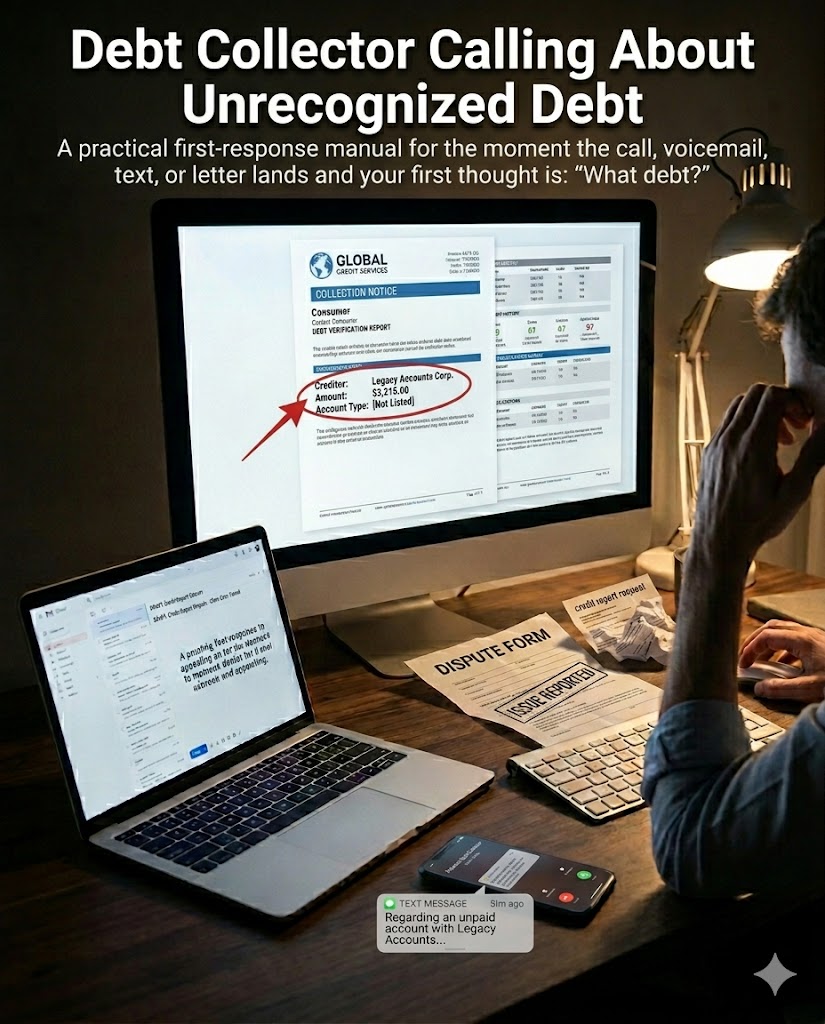
A practical first-response manual for the moment the call, voicemail, text, or letter lands and your first thought is: “What debt?”
This is not the same as ordinary debt collection.
This is a different kind of panic because the first problem is not:
- how do I pay?
The first problem is:
- is this even real?
- is it mine?
- is it a scam?
- what exactly are they claiming?
That distinction matters.
Current FTC guidance says that before you pay, you should confirm the debt is actually yours and not someone else’s or a scam. The FTC’s 2026 debt-collection alert specifically says that if you do not recognize the debt, you should send a dispute letter within 30 days and ask for written verification, such as a copy of the original bill. (Consumer Advice)
1) What this manual is for
Use this if:
- a debt collector is calling about an account you do not recognize
- you do not know the creditor name
- the amount means nothing to you
- the alleged debt might belong to someone else
- you suspect identity theft, bad records, old junk debt, or a scam
- your instinct is either to pay fast or hang up forever
This guide is U.S.-focused because the dispute and validation rules here are built around U.S. debt-collection law and CFPB regulations. CFPB’s debt-collection rule requires validation information at the start of collection activity, including the debt amount, creditor name, and dispute-right information. (Consumer Financial Protection Bureau)
2) The first rule: do not confirm the debt for them
When the caller says:
- “This is an attempt to collect a debt”
- “You owe…”
- “We need payment today”
your first instinct might be:
- “What? No I don’t”
or - “Oh maybe that old account…”
Both can be sloppy.
Do not give them:
- a confession
- your whole backstory
- your SSN
- your bank card
- your updated address history
- any emotional statement that sounds like you are accepting the debt
Do not say:
- “Yes, that’s probably mine.”
- “I think I remember that.”
- “Maybe I owe something.”
- “I can pay a little today.”
- “Let me give you my info.”
If the debt is real, you can deal with it later.
If it is fake, mistaken, or not yours, those lines make a bad situation worse.
FTC guidance warns that fake debt collectors exist and says scammers may demand payment for debts you do not recognize, refuse to give contact information, or pressure you with threats. (Consumer Advice)
3) What to do on the first call
Your goal on the first call is not resolution.
Your goal is identification.
Get:
- collector’s full company name
- mailing address
- callback number
- name of the creditor
- account/reference number
- amount claimed
- request for written validation notice
Script
I do not recognize this debt. Please give me your full company name, mailing address, callback number, the name of the creditor, the account reference, and send the validation information in writing.
That is enough.
The CFPB says debt collectors must provide validation information, and once you receive it you have 30 days to dispute the debt in writing. Failing to dispute in writing or within that time can affect your rights under the debt-collection rule. (Consumer Financial Protection Bureau)
4) The validation notice is the center of this stage
This is the key document.
You are waiting for the thing that tells you:
- who says you owe
- how much
- to whom
- what your dispute rights are
CFPB’s rule requires validation information including the amount of the debt, the creditor name, and information about how to dispute the debt or request the original creditor name if different. (Consumer Financial Protection Bureau)
Practical rule
If you do not recognize the debt, do not move into payment talk before you have the validation information.
Script
Please send the validation notice in writing. I will review it before discussing anything further.
5) The 30-day window matters more than people think
FTC’s 2026 alert says that if you do not recognize the debt, you should send a dispute letter within 30 days and ask for written verification, like a copy of the original bill. CFPB also says once you receive the validation information, you have 30 days to dispute the debt in writing. (Consumer Advice)
That means:
- do not sit on it
- do not keep telling yourself “I’ll look later”
- do not assume a phone complaint is enough
Practical rule
If the debt is unfamiliar, your best move is usually a written dispute inside that 30-day period.
6) What your written dispute should say
You do not need a dramatic essay.
You need a clean record.
Script
I dispute this debt because I do not recognize it and do not believe I owe it as stated. Please provide written verification of the debt, including the name of the original creditor, the basis for the amount claimed, and documentation showing that I am the correct debtor.
That is strong because it:
- does not admit the debt
- says you dispute it
- asks for specifics
- asks for proof you are the correct person
FTC and CFPB both say that if you do not think you owe the debt, you can dispute it and ask for verification or more information. (Consumer Financial Protection Bureau)
7) If you think it might belong to someone else
This is common enough that you should not feel weird about it.
Possible reasons:
- same/similar name
- old phone number reused
- address mix-up
- family member confusion
- sold debt with bad records
- identity theft
- clerical error
Script
I do not recognize this account and do not believe I am the correct debtor. Please provide the documentation you are relying on to identify me as responsible for this debt.
CFPB’s 2025 guidance says that if it is not your debt or you already paid it, you can provide documentation to support your dispute and ask the collector what evidence they have that you are the correct debtor and how they calculated the amount due. (Consumer Financial Protection Bureau)
8) If it smells like a scam
Treat scam suspicion seriously.
Red flags:
- they refuse to mail validation info
- they pressure immediate payment
- they demand gift cards, crypto, wire transfers, or odd apps
- they threaten arrest or law enforcement
- they refuse to give a mailing address
- they want personal information before identifying the debt clearly
FTC says fake debt collectors may demand payment for debts you do not recognize, refuse to give their mailing address or phone number, and pressure or scare you with arrest threats. (Consumer Advice)
Script
I do not discuss payment on unverified debts. Mail the validation information.
If they keep pushing:
end the call.
9) If they left only a voicemail or text
Do not assume the message means the debt is real.
Do this:
- save the voicemail/text
- do not click random payment links
- do not call back and start volunteering information
- ask for the same identifying details and validation information
CFPB’s debt-collection rule FAQ explains that collectors have communication rules and limits, including third-party restrictions, and debt-collection communication methods do not replace your right to dispute or request validation. (Consumer Financial Protection Bureau)
10) What happens if you dispute within the 30-day period
The model CFPB validation notice explains that if you write to dispute within 30 days, the collector must stop collecting the disputed amount until they send information showing you owe it. (Consumer Financial Protection Bureau)
That is a big deal.
Translation
Written dispute within the validation window is not just symbolic.
It changes the process.
This is why “I told them on the phone” is weaker than a written dispute.
11) If the debt turns out to be medical
Then you may have two layers of trouble:
- debt collection
- medical billing error / insurance / assistance issue
CFPB says if you think you do not owe the debt, the amount is wrong, or you already paid it, you can dispute it or ask for more information. For medical debt specifically, you should also verify with the provider, not just the collector. (Consumer Financial Protection Bureau)
Practical rule
Unknown medical collection is not just “pay or don’t pay.”
It may be:
- wrong person
- already paid
- insurance not processed
- provider error
- financial assistance issue
12) If identity theft might be involved
If the debt is completely unfamiliar and the details point to a real account in your name, you may not just have a collections problem.
You may have an identity theft problem.
Signs
- unknown credit card, loan, utility, phone, or medical account
- unknown address tied to the account
- other unfamiliar items on your credit report
- multiple strange collection attempts
FTC identity-theft guidance says unfamiliar creditor or collector contact can be a warning sign, and suspicious new accounts on your credit reports are a reason to treat the situation as identity theft. (Consumer Advice)
Practical rule
If this looks like fraud:
- dispute the debt
- check your credit reports
- consider freezing credit
- move into identity-theft containment, not just debt-collection defense
13) The expensive mistakes
Mistake 1: paying first, asking later
Because fear wanted the call to end.
Mistake 2: admitting the debt casually
Because you wanted to sound cooperative.
Mistake 3: missing the 30-day dispute window
Because you froze.
Mistake 4: relying on phone calls only
Because you did not create a paper trail.
Mistake 5: treating a scammer like a real collector
Because they sounded official.
Mistake 6: treating identity theft like a simple collection mix-up
Because you wanted the smaller problem to be true.
14) The clean sequence
If a collector calls about a debt you do not recognize, the right order is:
- get the company name, address, and claimed creditor
- ask for the validation notice in writing
- do not admit the debt
- send a written dispute within 30 days if you still do not recognize it
- ask for proof you are the correct debtor
- check whether this is really identity theft or a scam
That is the whole game early on.
Not:
- panic
- confess
- pay
- hope
15) Panic-mode version
If your brain is fried, do only this:
- get the collector’s company name
- get the mailing address
- get the creditor name
- say you do not recognize the debt
- ask for the validation notice in writing
- send a written dispute within 30 days
- do not pay on the first contact
That is enough.
16) One-paragraph summary
If a debt collector contacts you about a debt you do not recognize, do not pay or admit it in panic. FTC guidance says you should confirm the debt is actually yours and not a scam, and its 2026 debt-collection alert says that if you do not recognize the debt, you should send a dispute letter within 30 days and ask for written verification, such as a copy of the original bill. CFPB’s rule also requires collectors to provide validation information about the debt, including the amount, creditor, and your dispute rights, and written disputes within the validation period can trigger stronger protections than vague phone objections. (Consumer Advice)
Super-useful reads:
Micro Crisis Survival Manual #7: Debt Collector First Contact
Micro Crisis Survival Manual #6: Dealing With Medical Bill Panic
Bankruptcy Basics & Alternatives (US)

